Wednesday, August 29, 2012

First Bonsai

by Michael Rusnak
I know it sounds cliche, but kind of like your first love, there is something about your first bonsai.  Something close and something you just never forget.  I don't mean one of the cut-flower-like junipers that so many of us purchased somewhere only to find it was dead in short order--or when you bought it.  I mean that first tree that you worked with and kept alive.

Carlton's boxwood
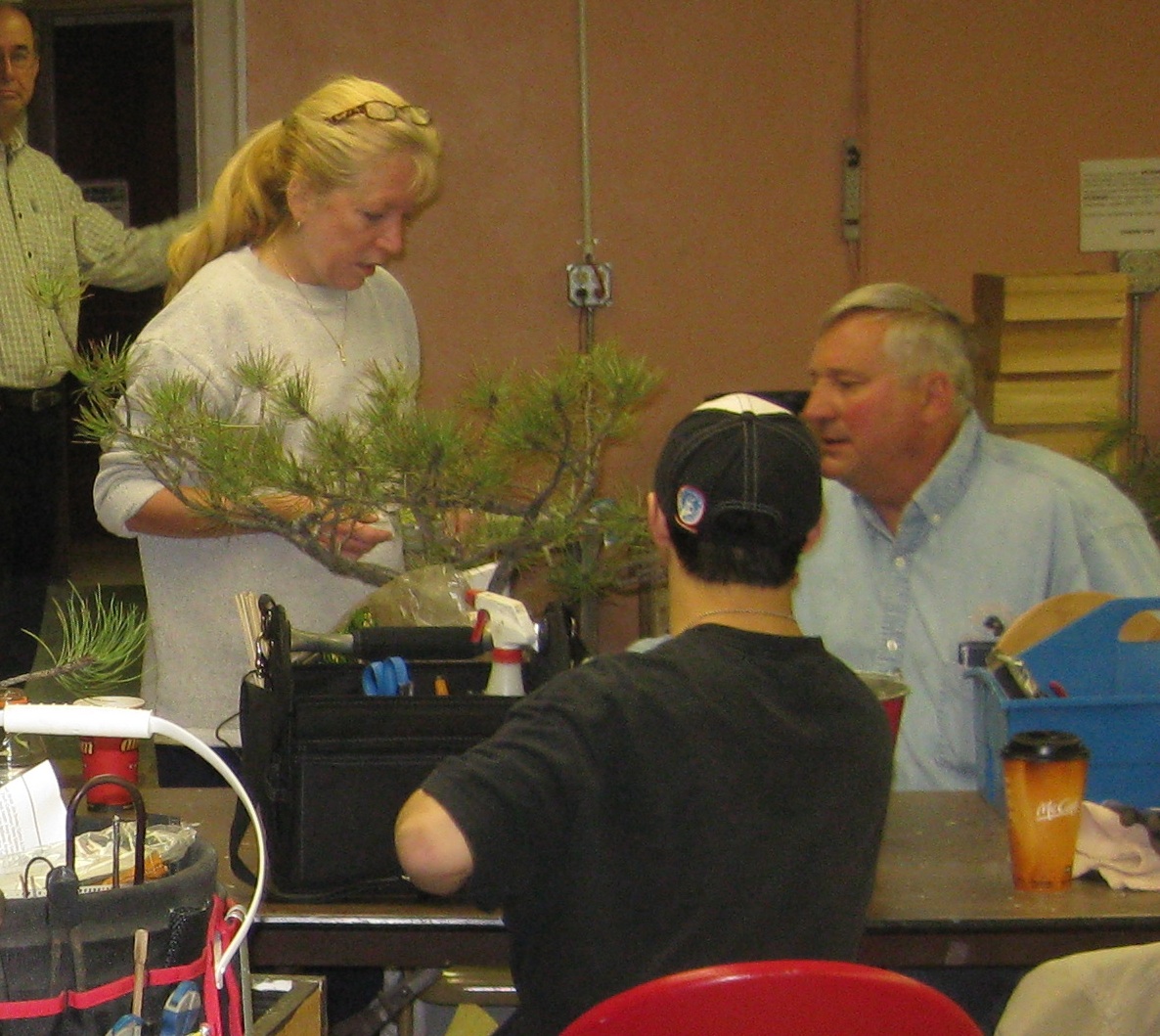
At the August ACBS meeting, while I was going around taking some photos of members' trees, I really admired the small  Kingsville boxwood that Carlton was tweaking.  For a small scale tree, it had an sturdy trunk. Plus its tight umbrella-shaped foliage crown--bright green and healthy-- off-set to the left, giving it a semi-cascade appearance. Anyway, the thing just looked great.  At some point in the discussion, Carlton added --"This was my first tree."  When he said that it stopped me.  I could tell from his expression that he had a genuine reverence for the tree and that it held a special place in his collection.  After all, it's the first one he kept alive, learned to re-pot, shape and prune.

Over the years most of of our members' trees seem to have some kind of story behind them-- and I suppose this sort of history is part of the appeal of the art of bonsai. This boxwood used to be in my sister's yard, and this yew was pulled out of a road ditch when my son was small, and so forth.

After the meeting, I was thinking that I still have my first tree, and I that haven't  really worked on it much over the last several seasons.  It was a nursery stock juniper that I tried to train for four or five seasons.  It was not just my first tree but one I kept alive. Unlike Carlton's boxwood, this one has just been sort of let go.  It's sitting in an area with several other junipers in nursery containers that I've been letting grow wild to thicken their trunks.

Anyway, when I got home I took it out and took a look at it. This exceptionally dry summer has beaten up the tree, and it was a mess with lots of weeds in the pot. I spent a few minutes just cleaning it up, getting rid of the weeds and dead leaves and stuff in the pot.  I then got out the clippers and cut away all of the dead sections, and proceeded to pinch back the foliage.  I decided that it wasn't that bad after I cleaned it up a bit. I left a few shoots that had extended near the top, thinking that if I fed it heavy now and early next season, I might be able to coax it into throwing up a strong shoot. This plan might make it's trunk continue over and upward a bit adding another level, like a tall literati that is often made from a staked juniper--see sketch.

While I was cleaning up the juniper, it occurred to me how many things I had learned or began to learn with this tree.  It was my first successful attempt at re-potting, and the first time I really tried to do a little wiring.  One thing I absolutely remember about this tree is that it was a sort of low sideways growing shrub.  I recall that it put out a real strong shoot, and I wired it upward so it would grow more into an informal upright tree.  I was surprised how it kept extending throughout that first season.

Here's something else I actually forgot about until now--a fat green caterpillar sort of taught me how to pinch the tree.  I remember coming out one day and looking at it, I noticed one small branch section was sort of mowed, mowed right down to little green nubs.  I looked closely, saw the caterpillar, sort of a tomato worm-like creature that I immediately cut in half with my clippers.  I was mad about the damage. A few weeks later, though, when new bright green shoots appeared expanding sideways, upward and elsewhere lush and thick all over from the nubs, I couldn't believe it. the branch looked better than anything I had tried to pinch out.  I felt bad about my rash act of cutting up the caterpillar.  He had nailed it. I understood better what people were talking about when they said pinch it way back.  So in a sense he showed me how to prune.

Much neglected
Anyway, I now felt ashamed that I hadn't paid much attention to this juniper, this special tree. In the same growing area, I spotted my first pine.  It was also overgrown and in need of some work. It was a black pine that I bought as nursery stock about that same summer I killed the caterpillar.  Back then, I was learning all from books, and you saw black pine in all or the the books on bonsai. The black pine was also the first tree that I thought to take a picture of before I began working on it.  That's my son in the picture--he's 27 now and an attorney working in D.C.  So that's how long it's been. And he, along with the tree, sort of mark the passage of time.

Although it's late now in the season, I gave the tree a little work, .  But thinned out, it's structure and what I was trying to do with it shows. I need to come back next weekend to do some wiring, especially in the upper section of the tree.

Thinning will add buds next year 
Black pine 1995
As with the juniper, working on the pine, I recalled it was the first time I really did some drastic pruning to begin a project.  I mean it took some time for me to work up the courage to saw off the top three feet of the tree when I started all those years ago.  It just seemed so crazy.  I also had to cut off a lot of root to fit it into a training pot. This was also the first go at stuff like pinching back foliage candles, and working to pull down and develop some branches. Looking at the cleaned up tree after part of an afternoon, I think if some small buds pop out next season, it should look presentable again about June.

So at the very least, our trees have an influence over us. But there is more. Carlton's understated remark --that it was my first tree was remarkable in a way.  It reminded me of how attached we are to them.  I thought of the little Japanese folk tale I read somewhere about a samurai who was out of fire wood on a cold night, and in order to make a fire for a guest, had to burn his beloved bonsai.  He did this without a word to his guest, keeping his emotions, his attachment to the trees to himself. Somehow, the folk tale seems more powerful in what he gave up.


Monday, August 13, 2012

Stan Hywet Exhibit


What a terrific opportunity for the ACBS to exhibit our trees in this lush, colorful and well-lit setting--the conservatory of Stan Hywet Hall and Gardens in Akron, Ohio. Stan Hywet Hall is as well-known for its Japanese and other gardens as it is for the mansion.

The week and a half long exhibit from August 4th through August 12th, 2012, entitled "The Art of Bonsai," was comprised of trees from nearly 20 ACBS members.  The gardens were hosting multiple events there throughout the week, including tours, a butterfly exhibit, weddings, and outdoor plays.  All of this meant a steady stream of visitors and great  exposure for our club--and for bonsai.  In addition, Cleveland Plain Dealer writer Roxanne Washington did a feature article on the exhibit in the garden section just prior to the event -- our own Gib and Matt were quoted on the history and object of bonsai.

Dan's juniper--it just gets better every year.
An ACBS show is always an exciting event.  It is enlightening to watch how from year to year members' trees are developing, and some are on the way to becoming genuine specimen bonsai. All you have to do is look back at our gallery pictures from past shows and you can see what has been accomplished. From season to season, they improve.  I have now gotten to the point that I simply love certain trees belonging to other members of the club, and I look for them right away.  It's like "Where's your big juniper, I've been looking forward to seeing it," or "Yeah, it's Dan's tree, but it's kind of mine too--because I like it so much." We sort of feel possessive toward our favorite member trees the way we do with old rock songs from back in high school-- you know, "That's my song," only instead it's "That's my tree."

I also liked seeing what members have done with their trees this year, and maybe I can learn something else from the way they've been styled or how the foliage has been pinched back.  In this sense, we learn the art together. And at the risk of sounding goofy, as a club and as individuals, our skills keep growing with our trees. More photos of the trees and the exhibit, as well as past shows, can be seen on our gallery spot.

At any rate, this has been an exciting event for our club, and we hope that the Stan Hywet exhibit brought the northeastern Ohio gardening community a chance to experience and appreciate the art of bonsai--especially our trees that looked so magnificent now in the height of summer.


Friday, July 27, 2012

ACBS to present "Art of Bonsai" exhibit at Stan Hywet Hall in Akron

"Art of Bonsai" Exhibit at Stan Hywet Hall in Akron, Ohio runs from August 4th to 12th
ACBS is pleased to announce that our members' trees will be exhibited in Stan Hywet Hall's magnificent gardens in Akron, Ohio. The week and a half long exhibit--from August 4th through August 12th -- is entitled "The Art of Bonsai." Stan Hywet Hall is as well-known for its Japanese and other gardens as it is for the mansion.

This is an exciting event for our club, and we hope that this will be a chance for the northeastern Ohio gardening community to experience and appreciate the art of bonsai--especially our pines and other trees that are looking right now so magnificent in the height of summer.


The exhibit will be open from 10:00 to 6:00 daily at Stan Hywet 714 N. Portage Path, Akron, Ohio 44303--see this link for a map.


Please join us for this event.  Later in August, photographs of the exhibit will be posted here on our events blog as well as on our gallery site.

Thursday, July 5, 2012

Growing Season Projects

At the July meeting, ACBS members shared some of their summer growing season projects.  Here are three gems.

1. Magnificent and sublime, this is a real specimen tree.  It's hard to believe what can be created out of discarded and overgrown shrubs.  You can see photos of this tree--as well as it's companion tree, pictured in the right hand column with the caption "Dan's Juniper"-- in some of our past exhibitions at our gallery site. In this video, Dan gives a 360 degree tour of one of his famous junipers:


2. It takes a healthy tree (and a brave man), but in this video, Carlton shows us how he is using leaf pruning and defoliation to further develop trident forest.  The results will be smaller leaves and greater ramification in the branches.  Photos of this forest at past ACBS shows can also be found on our gallery site.  


3. Fun with junipers--When neighbors rip out their overgrown shrubbery, we are there.  Unwanted shrubbery makes perfect stater material.  First, the price is right, since it's free.  Second, if they've often done the work of digging it out for you.  And third, there's often a lot of close in branches to choose from on a fairly hefty trunk.  Some cool junipers can also be found in inexpensive nursery stock. In this short video, Mike gives a tour of some juniper projects:


Thursday, May 3, 2012


Akron–Canton Bonsai Society  
presents a
Bonsai Exhibition
June 8th, 9th, and 10th
Cuyahoga Valley Art Center
2131 Front Street
Cuyahoga Falls, Ohio
Admission: free
Hours concurrent with Irish Fest

 
The exhibition will feature local bonsai artists and contain examples of various bonsai styles and species, including pines, elms, flowering and tropical trees. 

Saturday, April 21, 2012

Andy Smith Visits ACBS

Andy Smith discusses collected ponerosa pines.
One of the remarkable qualities about bonsai is its adaptability.  Although the art of bonsai originated in Asia, it can be adapted for native tree species from anywhere in the world. Among the tree species native to North America, probably the most well-known, internationally, for making outstanding bonsai is the ponderosa pine.

Andy Smith of Deadwood South Dakota recently presented a workshop with collected ponderosa pines for the Akron Canton Bonsai Society.  During the day-long event, Andy offered a slide presentation that showed the incredible character of the species.  The remarkable turns and undulations of these mountain trees tell stories of their struggles to survive in the tough rocky environment at high elevations in South Dakota.

He also talked about methods he has developed over the years to coax the trees from their growing places with minimal damage to the root systems. This often involves a crow bar and wedges, as well as a shovel, but he has learned to greatly increase his survival rate.


The trees offered to ACBS members were collected in areas where forestry management aims to thin the numbers of trees. He secures a permit to collect from the U.S. Forestry Service.

Andy demonstrated how to plant the collected specimens into training pots.  He explained that in most cases the trees are growing in small cracks in the rocks, and they are living in what little soil there is. Such growing conditions create a very dense root ball.  He used a chop stick he created spaces between the packed roots in order to allow watering to be more uniform. For the transplant into training pots, he recommended a fairly gritty soil mix.  He also believes that waiting out the coming summer season before attempting any styling on the trees would give the best chance for survival.  Being patient will allow the tree to recover and get healthy over the course of this season. Then in subsequent years, begin working on any pruning, wiring and other styling considerations. 


Many of the collected trees were estimated to be 40 to 60 years old.  The incredibly textured bark, as well as the deadwood and movement seen in some of the trunks of the trees was testimony to both the age and the conditions under which the trees were growing. The combination of these qualities, along the flexibility of the branches should, in time, make them excellent bonsai.


As few ACBS members in the have experience working with ponderosa pines, it might be helpful to also study information from clubs in western states.  A good summary of care and development of ponderosa pine for bonsai has been posted by the Phoenix Bonsai Club, which has a number of members who work with poderosas, at this link.   

Over the next several seasons, members are encouraged to bring their trees to club meetings, so that we can learn from each other and see how they are being styled and how develop. 

Much thanks to Andy for making the trek to Ohio, and also to our own Gib and Mat who planned and organized the event.

Sunday, April 8, 2012

Larch Forest Project-- Demo & Workshop

Ken and ACBS president Mat with the completed forest on a slab.
What a terrific April meeting.

I have to say, Ken pulled off a hat trick with this combined demo and workshop.  As he discussed some of the basics of creating a forest planting, Ken built this wonderful grove on a fiberglass slab.   In the photos at the right, you can see the larch seedlings spread out on the table as he selects the trees by size, thickness and number of side branches during the assembly. Ken explained why he chooses to prune the larches back at one point over another along the trunk for the forest, and how to clip the tap root so that the seedling would fit into the group.  He also discussed placeing the trees in such a way that the planting appeared natural and not contrived.
Having placed and worked all of the trees into the soil, he pointed out how he would next come back and prune the height of each tree so that the largest, and more dominant trees formed the apex of the entire composition.  At the same time, the smaller trees to the back and side contributed a sense of depth, and a feeling of the forest spread out across the horizon.  There was also a sense of perspective with the smaller trees now beginning to appear further away.

One of the of the notable points of Ken's forest was in his soil mix.  In addition to the mixture of grit (haydite and builder's sand) and organic material, Ken adds sphagnum moss right into the soil mix.  While some books recommend such techniques as using a mix clay and sphagnum to make a rim for a slab planting, putting the sphagnum right into the soil binds the mix, and seems to work well for holding the group in place. 

In the workshop, members put together their own forest groups, although on a smaller scale, using the bundles of nine larches as well as larger seedlings.

Below are several photos of our newly created groves.  (More pictures posted shortly) It will be fun to follow all of these forests over the next several years to see how they flush-out and develop--and also see them in their fall colors. In the coming years, we will add these to our Virtual Fall Show--you can see photos of trees from past autumns posted on ACBS's gallery spot at http://picasaweb.google.com/akroncantonbonsai