Monday, May 19, 2014

June Showcase: ACBS Annual Show


A Bonsai Exhibition
June 13th,14th and 15th  2014 Cuyahoga Valley Art Center
2131 Front Street
Cuyahoga Falls, Ohio
Admission: free
Hours concurrent with Irish Fest
  
By    By the
Akron–Canton
Bonsai Society


The exhibition will feature local bonsai artists and contain examples of various bonsai styles and species, including pines, elms, flowering and tropical trees.


We invite all of our internet friends to join us at our annual club exhibition in Cuyahoga Falls, Ohio.  Visiting bonsai enthusiasts and members of other bonsai clubs --please introduce yourselves to our members working the show.  Photographs of the exhibition will be posted on our gallery site  http://picasaweb.google.com/akroncantonbonsai

Tuesday, April 1, 2014

A visit to Tropical Bonsai Paradise – Wigert’s Bonsai Nursery, North Ft. Myers, Florida

by Matt Connelly, ACBS president

My family and I were on vacation over spring break in Florida. I was curious what Bonsai nurseries or groups were in the area. I happened to stumble upon Eric Wigert’s nursery in Ft. Myers. It was less than an hour from where we were staying. So when one of the days were blustery and over cast so we decided to take the road trip over to check it out.
I was absolutely blown away upon arrival. There’s over 5 acres of bonsai and pre-bonsai trees to take in.  Every conceivable size and type of tropical and sub-tropical trees was there for sale. Plus, he and his wife maintain over 150 specimen trees in their personal collection, many of which have been featured in prominent bonsai magazines or on display at Epcot.  These range from majestic pink bougainvillea to brazillian, rain tree forests.  It takes over 5 hours to water the collection! Needless to say, they do a happy dance during the rainy season.
He also has a small warehouse full of pots, small to giant sized and an impressive display of netsuke and Chinese mud men figurines. I fell in love with a few of the netsuke, especially these
adorable little oxen and Chinese style, jungle huts. Hopefully, they will compliment and add to the experience at the show this coming summer. I had to really exhibit some restraint when it came to buying trees. There were so many wonderful trees I’d love to own and
work on, but I have to think about how I going to care for this during the winter. I decided to admire them and wish for a time when I live in a more temperate climate.
My five year old was actually more entertained chasing chameleon lizards than playing on the ipad, and believe it or not we actually got more sun walking through the nursery than we would have at the hotel – so call it a win-win.
The local bonsai society meets there as well as many honored artists from around the world come to hold shows and classes.

If you are ever in SW Florida, I’d highly recommend stopping in. You won’t be disappointed.

Tuesday, March 4, 2014

A Study of Shapes for Bonsai

Pine in winter makes a neat literati model
By Michael Rusnak
Many bonsai sources point to nature as inspiration for bonsai--as well as models for styling a project.  So while this winter has left many of us in North east Ohio wondering if we'll be growing anything but icicles, and with our hardy trees tucked away, there's not all that much for the enthusiast to do.

Still, there is one thing that Northeast Ohio is famous for in the winter-- its eternally gray skies.  About November each year the gray curtain above us closes, and pretty much stays that way for the next several months.  The gray covering is infamous as a contributor to our seasonal depression as well as our deficiency of vitamin E.

The upside is this-- the gray sky is an ideal neutral and uncluttered background for study tree shapes.
Nice neatly rounded crowns

Often you can spot the oldest trees from a distance.  The neatly rounded crowns, curved umbrella-shaped outlines, or even flat tops in some species illustrate what the bonsai artist is attempting to achieve. These natural specimens show us the way. Plus the branching can be easily seen without a lot of clutter and interference.

When someone new to bonsai attempts to style a new project, it can quickly become apparent that creating a believable apex is is a skill
Apple tree in Ohio school yard
in itself.   Such apexes can help you visualize how your tree will look after a few years of training.


Similarly, the angular directions and down ward turns of old branches provide a details on what
to keep in mind for wiring.  It is also interesting to see just how amazingly intricate the ramification can become in a full sized tree. Something to emulate.

Also, I enjoy looking at the amazing shapes that some individual limbs can take on.  The very old oak tree pictured at right is an example. Look closely at the lower limb on the left.  The wonderful and abstract shape of this lowest branch tells a story of survival, survival of many storms of many seasons.  Still it endures.

Another opportunity to study shapes comes with travel.  And in a few past winters, I've been lucky enough to be in other parts of the country.  I put two photos below-- one from Washington DC where this amazing weeping cherry showed its structure in one of the town squares.
If you are lucky enough to be in Florida or Georgia in the winter, don't forget to take notice of the flattened tops of the bald cypress groves.  They can be seen from miles, lording over the young trees.  
 

Winter cherry  in Washington D.C.

Flattened crowns of mature Florida bald cypresses


Tuesday, December 10, 2013

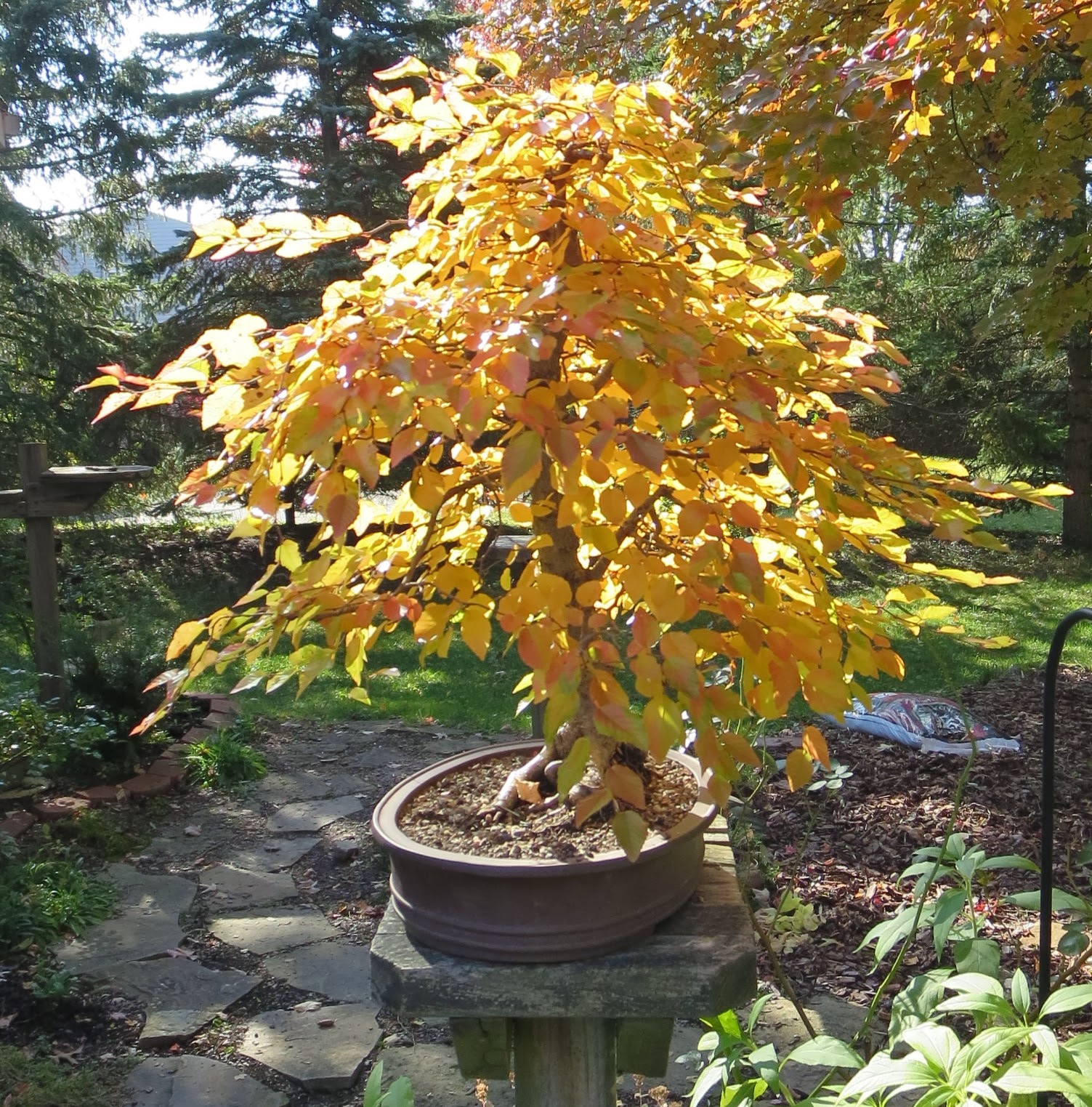
ACBS's Annual Virtual Fall Show

The Akron Canton Bonsai Society invites all of our internet friends to view our fourth annual Virtual Fall Show over on our gallery site: http://picasaweb.google.com/akroncantonbonsai


by Michael Rusnak
Why a virtual show?  It's mostly because of the timing.  While our club typically exhibits trees during the growing season, in past years, many members have talked about the idea of having a fall show.  Many species of bonsai, especially the maples and larches can be more fully appreciated if they are seen in their amazing fall colors.  However, because the species come into their colors at different times, sometimes weeks apart, it would be difficult to find a date for an exhibit. Additionally, the window of time when the colors are at their height in only a few days long, so one species might be at its height, while others would have already emptied their leaves.
Crab apple with its fall fruit
And so we present instead a "virtual" fall show, made possible through the magic of the internet.

By bringing trees to eye level, bonsai alters the human perspective. In this way, bonsai helps change attitudes, and shows the world the incredible beauty, strength, staying power and other illustrious qualities of trees. It is a type of life that is so different from us, yet how it reacts, survives and perseveres is the kind of stuff that lends itself to so many proverbs, symbolism and legends across many cultures.  This is but one reason why we love our bonsai, and present them here in photographs for others to enjoy.
Again we invite you to view our gallery:
http://picasaweb.google.com/akroncantonbonsai


Friday, July 26, 2013

Frank Leads Cotoneaster Workshop

Frank demos initial pruning (R) and one that has grown a bit (L)
by Michael Rusnak
At the July meeting ACBS members began creating bonsai from sizable cotoneaster nursery stock.  ACBS member Frank Mihalic lead the workshop.
The raw material was nursery stock that had be left to grow wild for the first half of this season.   Most were in 3 or 5 gallon containers and were sprawling with lots of long overgrown branches.

Frank first cut away the top couple of inches of the plastic nursery pot and pulled loose soil away from the trunk in order to expose a little more of the trunk, and at the same time allow for better viewing of the plant itself.  After studying the plant, he explained what he might cut away in order to create a skeleton for the bonsai.   He then pruned away several unnecessary branches and produced what will eventually become the trunk outline with some side branches --the basic structure for the bonsai.

The raw material
Turing the plant so that it could be viewed from multiple angles, he also explained that the next step was to feed the plant and let it recover and grow for the balance of the season.  This should allow the plant to respond with some foliage and begin to fill in the outline.  He also mentioned that it would be best to do any re-potting next spring at the start of the new growing season, after the pant had recovered.

The kids at play
Following his initial demo, Frank then worked individually with members, helping them study their raw material and suggesting what areas might be used to create the trunk-line and skeleton for branches, and what areas might be cut away.

It was great to see that much of the collaborative spirit from the club's benjing project carried over into the cotoneasters.  At one point much of the club was huddled around one of the trees.  A brief VIDEO of Frank working with members can be seen at this link.

Collaboration or How many ACBS members does it take to make a bonsai?