Tuesday, March 4, 2014

A Study of Shapes for Bonsai

Pine in winter makes a neat literati model
By Michael Rusnak
Many bonsai sources point to nature as inspiration for bonsai--as well as models for styling a project.  So while this winter has left many of us in North east Ohio wondering if we'll be growing anything but icicles, and with our hardy trees tucked away, there's not all that much for the enthusiast to do.

Still, there is one thing that Northeast Ohio is famous for in the winter-- its eternally gray skies.  About November each year the gray curtain above us closes, and pretty much stays that way for the next several months.  The gray covering is infamous as a contributor to our seasonal depression as well as our deficiency of vitamin E.

The upside is this-- the gray sky is an ideal neutral and uncluttered background for study tree shapes.
Nice neatly rounded crowns

Often you can spot the oldest trees from a distance.  The neatly rounded crowns, curved umbrella-shaped outlines, or even flat tops in some species illustrate what the bonsai artist is attempting to achieve. These natural specimens show us the way. Plus the branching can be easily seen without a lot of clutter and interference.

When someone new to bonsai attempts to style a new project, it can quickly become apparent that creating a believable apex is is a skill
Apple tree in Ohio school yard
in itself.   Such apexes can help you visualize how your tree will look after a few years of training.


Similarly, the angular directions and down ward turns of old branches provide a details on what
to keep in mind for wiring.  It is also interesting to see just how amazingly intricate the ramification can become in a full sized tree. Something to emulate.

Also, I enjoy looking at the amazing shapes that some individual limbs can take on.  The very old oak tree pictured at right is an example. Look closely at the lower limb on the left.  The wonderful and abstract shape of this lowest branch tells a story of survival, survival of many storms of many seasons.  Still it endures.

Another opportunity to study shapes comes with travel.  And in a few past winters, I've been lucky enough to be in other parts of the country.  I put two photos below-- one from Washington DC where this amazing weeping cherry showed its structure in one of the town squares.
If you are lucky enough to be in Florida or Georgia in the winter, don't forget to take notice of the flattened tops of the bald cypress groves.  They can be seen from miles, lording over the young trees.  
 

Winter cherry  in Washington D.C.

Flattened crowns of mature Florida bald cypresses


Tuesday, December 10, 2013

ACBS's Annual Virtual Fall Show

The Akron Canton Bonsai Society invites all of our internet friends to view our fourth annual Virtual Fall Show over on our gallery site: http://picasaweb.google.com/akroncantonbonsai


by Michael Rusnak
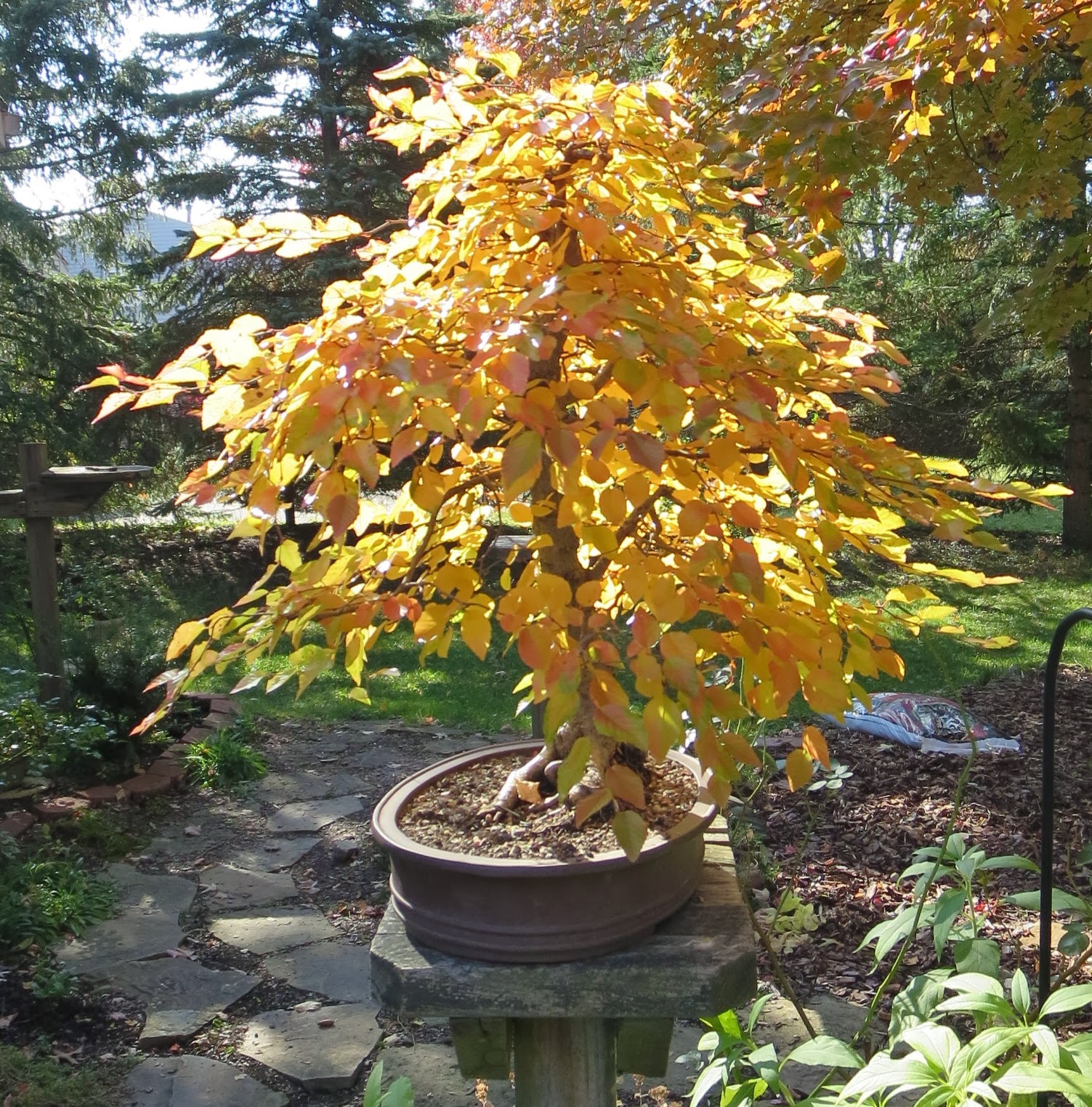
Why a virtual show?  It's mostly because of the timing.  While our club typically exhibits trees during the growing season, in past years, many members have talked about the idea of having a fall show.  Many species of bonsai, especially the maples and larches can be more fully appreciated if they are seen in their amazing fall colors.  However, because the species come into their colors at different times, sometimes weeks apart, it would be difficult to find a date for an exhibit. Additionally, the window of time when the colors are at their height in only a few days long, so one species might be at its height, while others would have already emptied their leaves.
Crab apple with its fall fruit
And so we present instead a "virtual" fall show, made possible through the magic of the internet.

By bringing trees to eye level, bonsai alters the human perspective. In this way, bonsai helps change attitudes, and shows the world the incredible beauty, strength, staying power and other illustrious qualities of trees. It is a type of life that is so different from us, yet how it reacts, survives and perseveres is the kind of stuff that lends itself to so many proverbs, symbolism and legends across many cultures.  This is but one reason why we love our bonsai, and present them here in photographs for others to enjoy.
Again we invite you to view our gallery:
http://picasaweb.google.com/akroncantonbonsai


Friday, July 26, 2013

Frank Leads Cotoneaster Workshop

Frank demos initial pruning (R) and one that has grown a bit (L)
by Michael Rusnak
At the July meeting ACBS members began creating bonsai from sizable cotoneaster nursery stock.  ACBS member Frank Mihalic lead the workshop.
The raw material was nursery stock that had be left to grow wild for the first half of this season.   Most were in 3 or 5 gallon containers and were sprawling with lots of long overgrown branches.

Frank first cut away the top couple of inches of the plastic nursery pot and pulled loose soil away from the trunk in order to expose a little more of the trunk, and at the same time allow for better viewing of the plant itself.  After studying the plant, he explained what he might cut away in order to create a skeleton for the bonsai.   He then pruned away several unnecessary branches and produced what will eventually become the trunk outline with some side branches --the basic structure for the bonsai.

The raw material
Turing the plant so that it could be viewed from multiple angles, he also explained that the next step was to feed the plant and let it recover and grow for the balance of the season.  This should allow the plant to respond with some foliage and begin to fill in the outline.  He also mentioned that it would be best to do any re-potting next spring at the start of the new growing season, after the pant had recovered.

The kids at play
Following his initial demo, Frank then worked individually with members, helping them study their raw material and suggesting what areas might be used to create the trunk-line and skeleton for branches, and what areas might be cut away.

It was great to see that much of the collaborative spirit from the club's benjing project carried over into the cotoneasters.  At one point much of the club was huddled around one of the trees.  A brief VIDEO of Frank working with members can be seen at this link.

Collaboration or How many ACBS members does it take to make a bonsai?


Tuesday, June 11, 2013

2013 June Exhibit Features Full Penjing Landscape & Fine Bonsai

Eleven section penjng landscape
The June 2013 ACBS showcase exhibit featured the first ever exhibit of our composite penjing landscape, as  well as number of fine member trees, many of which just get better every year.  In addition to photographs, our gallery site also contains a brief video walk-through of the exhibit.

Trident Forest
Outstanding Elm
Visitors to the exhibit were greeted by the wide expanse of the full eleven section penjing landscape that was the club project for this year. It was the last step in a design conceived by ACBS member Carlton Buck who back in September first proposed doing tray plantings that be viewed separately or assembled to form one large landscape.   The ongoing project has been written about here on this blog as it progressed though the winter and spring months.  In addition to photos on our gallery site, the video walk through posted there gives a little bit better indication of just how cool the completed penjing looks.
Two concord grape vines

Large Juniper
The exhibit also contained bonsai from members at all skill levels with nearly twenty participating members.  Among the visitor favorites were the trident maple forest, the large junipers, the miniature mame plantings, tropicals, several
pines and the two grape vines. You can see photos of all trees in the exhibit as well as a short video walk thought on our galley spot at this link. Enjoy.

Friday, June 7, 2013

Material for Bonsai: from Trash to Exhibit


by Michael Rusnak
ACBS Newsletter Editor

Some of the bonsai trees in our club's June exhibit were created out of shrubs, stumps and other material that was destined for a trash heap or the wood chipper. If the discarded shrubbery is “usable” and is successfully transplanted to a pot, it can have a new life as a bonsai.

Such material is like having a blank canvass from which something spectacular can be created over several seasons. 

Akron-Canton Bonsai Society member Dan Tullius collected a massive juniper from a park that was being renovated in 1994. After successfully transplanting it into a training pot, Dan has worked to create some spectacular results. 

The juniper just gets better every year, and like many good trees, it can be viewed from either side.  It has many interesting shapes and movement all around it's sizable trunk.  

What was once thrown-away has found a new life as a bonsai, and in this case Dan has created a real specimen tree.

Friday, May 17, 2013

Piecing Together the Penjing Project

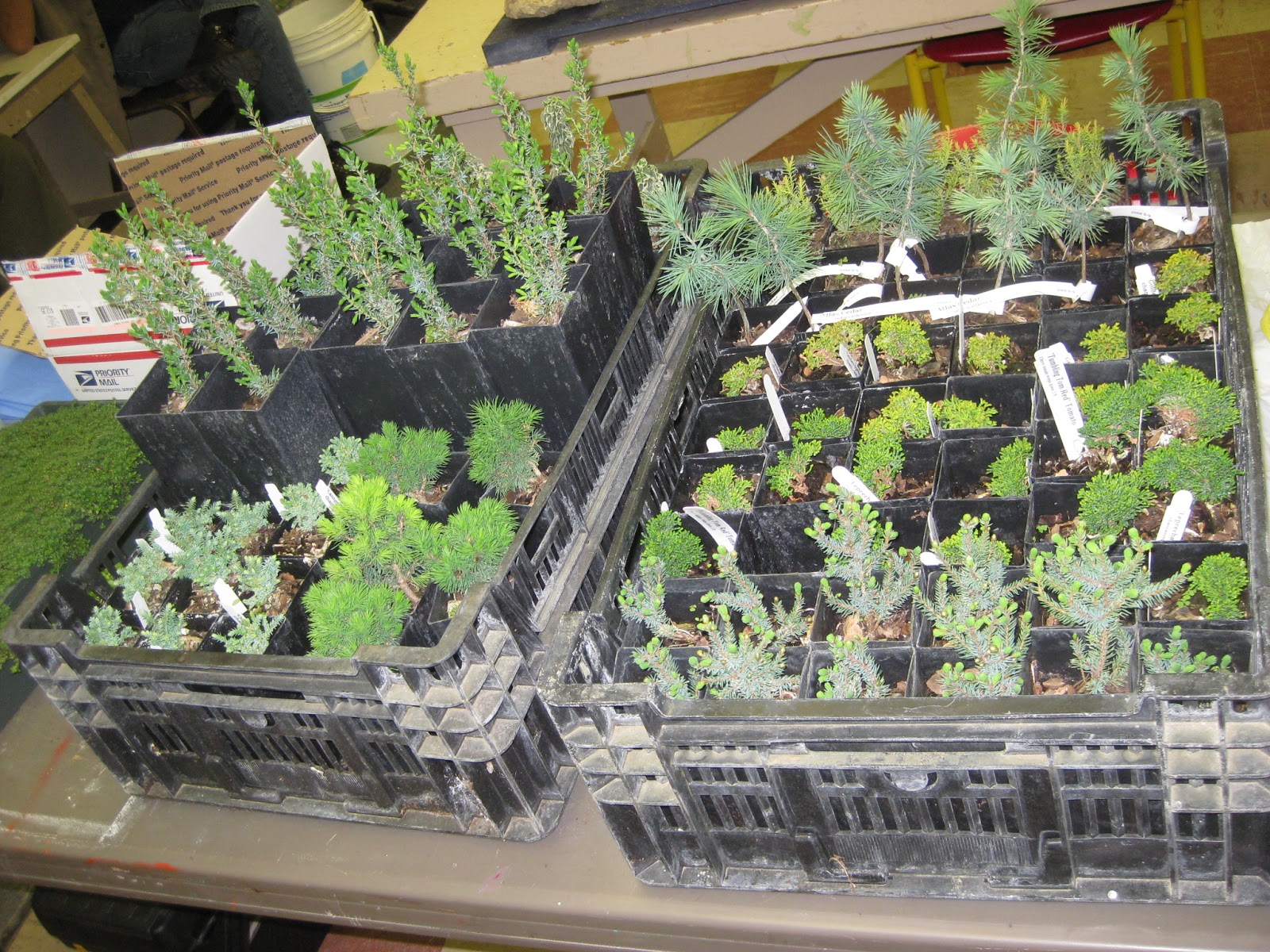
At its May meeting ACBS members began planting some of the dwarf
Dwarf evergreens and other plant material
evergreens into the rock hollows and land features of the pejing.

It was obvious even in just setting down the plants in their nursery containers that their colors would work to add a sense of unity from one section to another.  So a little coordination was necessary. Form a little distance, the colors of the plants stand out quite well against the earthy shades of the rock features and the dark blue of the tray.  In short it worked visually.  In just completing two or three section the foliage color accented and highlighted these features.

Two adjoining sections of the ACBS penjing
Given that many of the ACBS members participating in the project have little or no experience working with tray plantings, one question presented itself:  what kind of soil to use? It seemed that such small plants would have difficulty surviving in typical, fast-draining bonsai soil.  The land features are quite shallow, and the space in the rock hollows is limited. Most choose to use the same heavily organic mix from the nursery containers, and then add some type of top dressing like haydite which has good earthy tones. We'll need to keep and eye on the watering situation,

 So now the only trick will be keeping things alive.


Friday, May 10, 2013

Spring exhibits and ACBS is Named "Artist of the Month"

The ACBS Named was recently named "Artist of the Month" and will be presenting two exhibits in the coming weeks.

The first exhibit will feature about 20-25 trees at the Yoga Place in North Canton, Ohio from Friday, May 31 to Sunday, June 2nd.    In addition to regular classes in yoga, meditation, and fitness, the Yoga Place studio frequently sponsors cultural events.  ACBS was invited to present an exhibit on this special weekend which also features music and a tea ceremony.  In appreciation, the Yoga Place has named the Akron-Canton Bonsai Society its"Artist of the Month." Such recognition is greatly appreciated. You can see the posting on the Yoga Place's website and blog at this link.

ACBS will also present its annual June show at the Cuyahoga Valley Art Center June 7 through June 9.  Hours will run concurrent with the Irish Fest 2131 Front Street, Cuyahoga Falls, OH 44221-3219. 
Photographs from previous exhibits can be seen on our gallery site:
at http://picasaweb.google.com/akroncantonbonsai


             The
Akron–Canton
Bonsai Society 
presents a

Bonsai 
Exhibition
June 7th,8th and 9th
Cuyahoga Valley Art Center
2131 Front Street
 Admission: free
 Hours concurrent with Irish Fest


The exhibition will feature local bonsai artists and contain examples of various bonsai styles and species, including pines, elms, flowering and tropical trees.