Friday, June 23, 2023

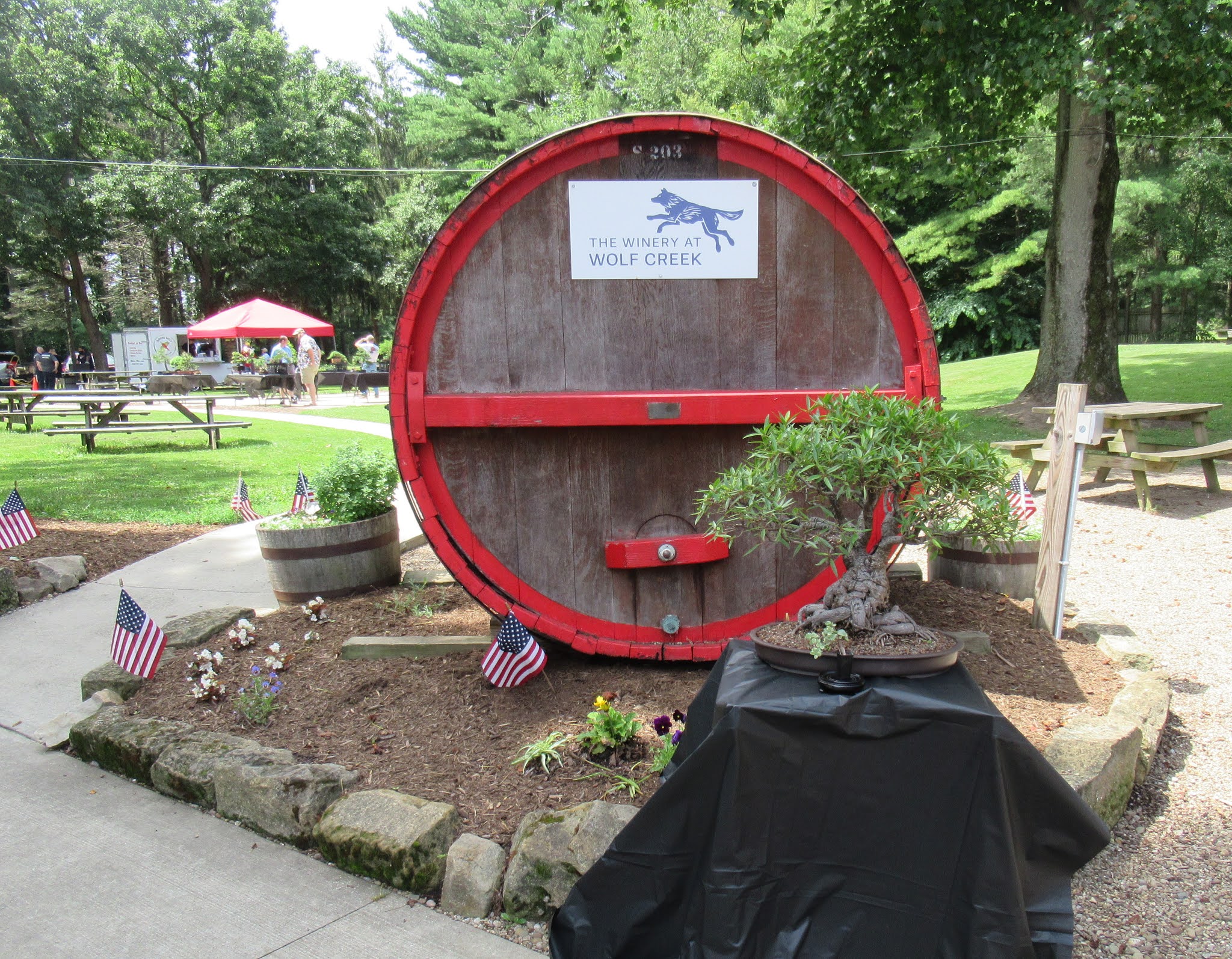
Welcome to Akron Canton Bonsai Society's June Exhibition at Wolf Creek Winery


 The Winery at Wolf Creek and the Akron  Canton Bonsai Society welcome you to our June exhibition and to the wonderful and fascinating art of bonsai. All trees are designed, trained and cared for by members of the Akron Canton Bonsai Society
 
  The word "bonsai" simply means "potted tree." Although bonsai began in Asia, it can be applied to native trees anywhere in the world. Bonsai brings a piece of the natural world into a pot and offers reminders of seasonal growth and changes.  It brings ordinary trees to eye level, and forces you to notice details—shapes, colors, textures.  It tells the story of the tree.

Bonsai changes attitudes, and thereby can change the world.  We hope you enjoy this presentation of this wonderful and fascinating art.

Feel free to take pictures of our trees

Take a selfie with a tree too. Post on Instagram, if you like and tag us--

@akroncantonbonsai

@bonsai.mike2020


 Some Bonsai Facts

  • The word "bonsai" simply means "potted tree."    In Japanese, it's pronounced "bone-sigh"
  • Bonsai is part art, part plant science 

  • Bonsai began in China sometime around AD 700, then spread to Japan before AD1200 and elsewhere in Asia
  • Although bonsai originated in Asia, it can be applied to native trees anywhere in the world.  In the US, for example, ponderosa pine, and tamarack (eastern larch) make spectacular bonsai.
  • Bonsai can vary in size, some traditional trees are in pots so large it takes two guys to carry them.  Others are in small, Barbie doll-sized pots 

  • As art, bonsai brings ordinary trees to eye level. It invites you to notice details--shapes, colors, textures, contrasts & seasonal changes

  • Bonsai can be created from wild trees, nursery stock or discarded shrubs
  • Training:  Wiring and pruning are used to train the tree, and help shape it to look old. Wire is generally removed after a growing season.  
  • Trees are periodically re-potted and root pruned.
  • Typically developing a bonsai typically takes 5 years. The fun is in this process. 

  • Many ACBS club members create bonsai from inexpensive nursery stock or shrubs that have been thrown away.
  • The National Arboretum in Washington DC has trees that we gifts from Japan.  Some have been in training since the 1600's.
  • It recently came to light that one of the oldest bonsai in the US Collection survived the Hiroshima blast.  It was behind a garden wall and was one of the trees that were a gift from Japan.
  • A few are hundreds of years old-- US National Collection in Washington DC has some that date to 1600"s
  • Some bonsai tell stories of life, resilience and survival.
  • A well-cared for bonsai may outlive its owner


Bonsai can change attitudes toward trees, nature and the natural world.  Bonsai can help save the world. 

We'll post a video tour of this exhibit on our youtube channel 

https://www.youtube.com/@AkronCantonBonsai

 The Akron Canton Bonsai Society was established in 1995 to understand, enjoy, and learn the ancient living art of bonsai.  Members exchange ideas, collaborate and study to develop the skills to create their own bonsai.  ACBS holds yearly exhibitions to share our trees and introduce the community to this wonderful art.  In short, it’s all about the trees.


Monday, July 12, 2021

Akron Canton Bonsai Society July 2021 Exhibit at Wolf Creek Winery

By Michael Rusnak

Strolling though bonsai trees while sipping a glass of wine on a gorgeous summer afternoon--that's just about perfect.

This year, the Winery at Wolf Creek in Norton, Ohio hosted our club's July exhibition.  In a picnic-like setting of wonderful overlooks across a valley and vineyard, the Akron-Canton Bonsai Society presented a display of trees.  It included pines, larch, yew, juniper, maple, as well as several tropical varieties.  

There were examples of several traditional bonsai styles as well by members of our club at all skill levels.

The idea for a bonsai exhibit at a winery was a stroke of genius by our club president during the long months of the last year's Covid19 pandemic lock-down. As there are no public conservatories or arboretums in our area, we were looking for venue for an outdoor exhibit where people stroll and want to enjoy beautiful things.  It was just about a perfect match.

While our original exhibition date in June was rescheduled due to storms in the area, this make up day turned out to be picture-perfect weather for the event. 

 The perfect weather brought out a steady stream of visitors, and we would suggest that other bonsai clubs might want to try a winery for a summer exhibit. Additionally, we had no problem getting club members to volunteer to work the exhibit.  The good weather, the setting and readily available refreshments were enough of a draw.

One of the things that I always enjoy about our club exhibits is seeing the trees and projects that other members create.  I enjoy seeing how their trees develop over time.  And unlike your own trees that you work with throughout the seasons, you mostly only see those of other members once a year.  The progress and refinement therefore is at once noticable.  That yearly progress is a genuine joy to discover.  In this way, the trees themselves have also become club members. 

In total we had more than half of our membership represented in the trees displayed. And it just felt soooo good to be out again with friends, visiting, enjoying the art of bonsai after the calamity that was last year.  Enjoying the event with  good glass of wine didn't hurt either. 

Also, enjoy this video tour of our July exhibit at Wolf Creek Winery our our club Youtube channel.


Thursday, May 14, 2020

Trident Seedling Work

Debbie shared two photos of another spring project.  She has been working on  Trident Maples
Roots over rocks and tying them with wire. 

She commented that it was a "Very difficult.  I was snapping off some of branches.  I need a class on wiring."
She hopes they will survive and have a productive growing season.

Monday, May 4, 2020

Lexi Trims Brazilian Rain Tree


Denny submitted this look at her new helper, Lexi, working on a Brazilian rain tree.  Looks like he's serious about his new day job, but I hope someone told Lexi that tree has thorns. 

Thursday, April 16, 2020

More Spring Bonsai Projects by ACBS Members

With the whole state still on lock down, we are sharing some of our spring projects  here on our blog.  This week, I've gotten three more messages with pictures from our members.

First up, Debbie sent in this photo of her amur maples from last year's club dig. The maples are looking healthy and busting our all over. And just look at that rugged old trunk. 

She also sends photos of these two small flowering bonsai, a crab apple in a white hexagon pot, making that spring color really pop.

Plus this small azalea already flowering with some warm purple colors.  Very cool. 


Ken adds another spring project.  He says,
"When in doubt, get some Rocks out...?"
This is the same Root over Rock Trident Seedlings ON the Rock method we did the last couple years at my ACBS Spring Workshops.
Ken is using the Seedlings intended for our Workshop last night and making more Root over Rock for the next couple days . He is going to try some Virginia Pine today and have used Elm already too. Maybe Shimpaku next?
Root over rock before and after tie down

Additionally, Ken proposes a 2020 Root over Rock Challenge to Members to see their ROR on this Blog? Hopefully there are some from the last 2 years that we can see!  Amen Ken. That would be awesome.


Lastly, Emmett and Randy finished repotting a group of amur maples from last years dig, and these too have responded nicely with ample shoots pushing our all along their trunks, as can be seen in this photo they sent.


Wednesday, April 1, 2020

Ken Works an Erodium

Ken shared these before and after cutting photos of an erodium he pulled out of a growing pot this week. He describes it as "a roughly cut, erodium project just started."

For those of you who aren't familiar with these little guys, they are a lot of fun to grow and put out bright flowers throughout the growing season. Plus they make neat mame size bonsai.

As can be seen in the photos, he's potted it up and cut the plant way back.  But take note of that trunk and all its ripples and texture.  Nice.

It won't be long before the erodium puts out new shoots and leaves.  It should look great in a few weeks.


Spring Dig-- Eastern Red Cedar

This season due to the corona virus, and our club not actually meeting, we'll be periodically posting some of the projects club members are working on so that we can all share in each others projects, the excitement and energy that the trees bring. In other words, virtually, we can share some of what bonsai has to offer-- bonsai reveals the glory of spring.

Eastern Red Cedar Yamadori Just Dug Out

Nice trunk with lots of branches
Having just moved back to Ohio last year, AJ is  not only back in the ACBS club, but already scrapping out some new material for bonsai.  I guess tree work is just in the blood.

Check out AJ's new projects, an eastern red cedar just pulled out of the ground, and lugged out of the wild.  From the pics, it looks like it has a serious trunk and lots of branches to choose for a new leader and to dead wood.  

Plus he's already go it potted up in a big training box.  But hey, is that work position is hard on the back? Just kidding, I wish I could still do that.

Anyway, this we'll all look forward to see how that tree develops in the coming seasons.


Tuesday, March 31, 2020

Another Spring Project: Buckey Bonsai in Training

This season due to the corona virus, and our club not actually meeting, we'll be periodically posting some of the projects club members are working on so that we can all share in each others projects, the excitement and energy that the trees bring. In other words virtually we can share some of what bonsai has to offer-- bonsai reveals the glory of spring.


Buckeye literati-- sweet direction changes
Buckeye bonsai in training

Randy continues his experiment at using Ohio's famous state tree--the BUCKEYE. These trees have very broad umbrella shaped leaves, and because of the large leaf size, they are not used much for bonsai.

A couple of years ago, Randy gave a presentation to our club with multiple examples of buckeyes that he had been working with. Despite the leaf size, they typically have wonderful greens and red shades in their spring  foliage color.   In addition they develop some interesting direction changes with pruning--see our post from July 2018.  At that meeting, he gave each member a buckeye to work on, all were trees that he had grown from seed. (By the way, mine is still alive).

Here Randy shares some pics of this delightful little guy which, in time, should make an interesting literati style with lots of abstract movement. Just check out that lower trunk  It is already giving us some cool lower trunk bends and direction changes.

Check back to this blog later for more spring projects.
Stay safe.


Spring Pojects Potting Up-- Maple

by Michael Rusnak

This season due to the corona virus, and our club not actually meeting  I'll be periodically posting some of the projects club members are working on so that we can all share in each others projects, the excitement and energy that the trees bring. In other words virtually we can share some of what bonsai has to offer.

Amur Maples

Last year our club dug up more than 30 amur maples from a hedge row that was in front of the building where we were meeting.  These 50 year old trees all had thick trunks with lots of hollow and movement.

Several of the trees were healed in the ground to recover at one member's home.  This past weekend several of the maples were put in training pots.  Emmet and Randy shared the pictures below.  They report lots of healthy root, and the maples are already pushing out. It should be a good year of development.


Monday, October 14, 2019

Artist Adam Jones Holds Workshop with ACBS

By Michael Rusnak

The Akron Canton Bonsai Society was honored to host a workshop with visiting bonsai artist Adam Jones in October at Silver Springs Lodge in Stow, Ohio.  Mr. Jones trained at the world famous Bonsai Village and Bonsai Museum in Omiya, Japan.  He is the only westerner to own a successful bonsai nursery in Japan.  The workshop was arranged and sponsored by the Japanese Consulate General in Detroit.

The workshop began with a discussion about our club's major project for this year, the 30 plus amur maples that we dug this past April.  Mr. Jones offered plenty of good advice on care as well as a plan to train them into bonsai. Working with one of the maples that had grown wild this past summer, he discussed several important tasks, including selecting a front and visualizing an overall design for the tree.  He also discussed how to select which branches to keep to develop branch structure. He also talked about pruning, building ratification. A video with some of his comments about developing the amur maples can be seen on our youtube channel.

Members participating in the workshop brought current bonsai "works in progress." These trees are in need of some good direction and coaching to bring them to the next level.  There were several different species of trees, including maples, pine, juniper, spruce and yews. Additionally, we are also always looking to improve our own skills so that we might in the future create better bonsai.

Working like a chess master playing several different games at once, Mr. Jones went from member to member giving detailed advice on design, pruning and care of the trees. He talked about some of the important considerations when beginning a tree project, such as studying the tree, selecting a front, the most advantageous planting angle, and other aspects of overall design.  He was very specific and detailed in his instruction.  For example, in discussing some pruning the overgrown branches on evergreen such as spruce
or yews, he talked about which side branches to keep. Ideally left and right, eliminating those growing straight upward which will pull strong energy from the tree, and eliminating those growing downward from the branch which will become weaker.  He also noted the importance of identifying the leaf buds, points that determine how far back you can clip.  We have posted a video of parts of his discussion on pruning these still developing trees on our Youtube channel.

In addition to the workshop with ACBS, Adam's visit to Ohio included a demonstration at the Cleveland Botanical Gardens, as well as a lecture at the Franklin Conservatory in Columbus.

Stock Spruce
At his presentation in Cleveland, Adam discussed creating a bonsai from nursery stock and transformed a stock spruce tree. The photo at the right shows the spruce as it was purchased from a local nursery, and below how it appeared after Adam did some well thought out pruning and wiring.  As shown in the photo, the planting angle of the tree would also be adjusted when re-potted in the spring. 

The Akron Canton Bonsai Society would like to thank Adam Jones for his patient, thoughtful and practical help and direction with our tree projects.  We would also like to sincerely thank the Japanese Consul General for selecting our club for this this terrific workshop. It was greatly appreciated.
Spruce after styling by Adam Jones


Sunday, August 25, 2019

Bonsai Ace Jim Doyle Visits ACBS

by Michael Rusnak

This Last week of August, visiting bonsai artist Jim Doyle of Natures Way Nursery in Pennsylvania held a "bring your own tree project" workshop for ACBS members. Members brought several different species, including  junipers, spruce, ficus, raintree, and pines.

Jim spent time evaluating each of the trees members brought for the workshop.  He advised members, on proper care, design and developing the trees into better bonsai.

In addition, Jim was asked for advise on our clubs main project this summer-- developing the 50 year old maples that were collected from the front of the building where the club has been meeting. (Scroll down and see our April post)

Working with one example from the hedge dig this past spring that has been left to grow wild this season, he commented on the attributes of the species and gave several suggestions for how to develop foliage, keep the tree healthy, and also how to feature and preserve the dead wood and hollow areas of the trunk.  See this video of some of what he had to say at this link to our Youtube channel.


Jim added the following points about amur maples:
  • One of the best maples for fall color
    Responds with lots of growth when cut back
  • Likes a lot of water
  • When developed will adjust to shallow bonsai pot
  • The species is very winter hardy and does well in Canada
  • Branches can be easily air-layered to get new trees
  • Clean soft wood from hollows and dead areas, use PC wood hardener to preserve area
  • Thread grafting works well if branches needed 


Monday, August 5, 2019

Yew Bonsai Progression

by Michael Rusnak

May 2015

Developing a bonsai from raw material is typically a five year project--at least. I mean to get a tree to the point where it starts to look presentable. If nothing else, photos can help you see how much a tree has progressed.   In 2015 several shrubs were donated to ACBS by a gentleman who was moving out of state. They were plants that had been dug out and potted, as can be seen in the photo from 2015. That summer I pruned the foliage ends back and fed the plant over the course of the season. I wanted to encourage some back budding closer in to the trunk.
May 2016, planting angle adjusted

The following spring, I re-potted the yew and changed the planting angle, rotating the lower trunk to allow a lower branch to become its new trunk. (low branch on right in the 2016 photo).  I recall it had been planted in sand, and had a nice healthy root system. The tree responded well to the pruning, and it was putting out some new shoots, closer in to the trunk, but mostly on the upper branches.
June 2019, after being allowed to mostly grow wild

I continued to prune the ends of the foliage, and except for that, I continued regular feeding and let it grow mostly wild for the 2017 and 2018 seasons.
August 2019


The tree put on some nice growth, as can be seen in the photo taken in June 2019.  This past month, I did some wiring, trimming and shaping to try to bring the yew into a more conical shape.  I also removed much of the dead branches on the lower portion of the trunk.  I was hoping to keep more of it, but the lower dead branches mostly came straight at the viewer, and I thought the bulk of it interfered with its trunk line. So Some of it was removed. I think it's taking shape now, and is much transformed from what it was back in 2015.


Anyway, we'll see how it responds over the balance of the summer and next spring. I'd like to see the foliage come down a bit lower, and I still need to do a little carving on the dead wood areas.  More refinement will need to be done in the coming few seasons, and in time, it should make a fine bonsai.


Sunday, June 16, 2019

ACBS Summer Exhibit At Akron's Stan Hywett Botanical Gardens

ACBS has partnered with the beautiful and historic Stan Hywett Hall and Garden this summer to be part of their "Art in the Garden" series of events.  The hall is famous its botanical gardens as well as its architecture.

Our club will have a month long display of tropical bonsai in the beautiful and spacious conservatory on the grounds from June 15th to July 14th. For the event the Stan Hywet greenhouse director Joe Mihalik created special stands of varying height from the trunk of a large spruce tree.  The stands are arranged in three and five tree groups, and display the trees against the neutral sky background of the greenhouse glass.  In addition the Gardens graphics department added signs with information and facts about the art of bonsai that were placed with each tree.

Because of the heat that can build in a summer greenhouse, only tropical bonsai were part of this
extended exhibit. Several tropical varieties are present, including several varieties of ficus, Brazilian rain tree, and Jaboticaba. Many trees in the exhibit are paired with miniature "mame" companion bonsai.  In addition to the tropical bonsai,  the club will exhibit a small number of pines and other winter-hardy species on two weekends when ACBS members will be present to talk with visitors and  some demonstrate the process of creating a bonsai from raw nursery stock.  Club members will be at the Stan Hywett conservatory on Saturday June 22 and Sunday June 23 from 10:00 to 4:00,  and also on Saturday July 13th and Sunday July 14 from 10:00 to 4:00pm.

We invite all of our internet friends and members of the bonsai community to visit our exhibition.
 Watch a short video tour of the exhibit on our youtube channel at this link.


Sunday, June 9, 2019

ACBS Mini Show at Rohr's Nursery

It is always surprising how many interested people show up to talk about bonsai. This first full weekend in June was no exception as word got around that ACBS was displaying some of its and demonstration how bonsai can be created from ordinary nursery stock.
The nursery hosted the mini show in its neat out door gathering area, sort of a garden within the garden, where the club set up and did a little tree work. Emmett carved up a couple of 5 gallon size boxwoods to show how the process begins.  Members talked with visitors about such things as how to pick out a good candidate for bonsai from stock material, what species are good first time attempts and general care questions.
So relaxing--working on a tree with friends on a terrific June afternoon. 


Tuesday, May 28, 2019

Azalea, Five year Progression

Azaleas picked up while on a run, 2014
by Michael Rusnak

One of my favorite things about the art of bonsai is how you can create something out of nothing. A tree headed for the shredder or landfill, can get a whole new life as a bonsai.

Even better is the process.  Although it may take five to ten years to become a presentable tree, it gives you a lot to cheer about along the way. Let me show you how many cheers this clump of azaleas has given me.

Clump as picked up, 2014

I was out for a run one spring morning in 2014. I spotted this over grown, bug damaged azalea clump.  It had been dug out by a neighbor and left on the curb for the trash.  There were some interesting shapes along its base, and when I picked it up, it broke into two main pieces.  So I brought them home to see if I could get them to live in a pot.  Both sections pulled apart into several plants.  Unfortunately, the largest one which had a trunk nearly as thick as my wrist and was full of ripples and movement had a lot of damage where it was removed, and did not survive.

Now three tree grove in 2016
The other sections survived. One was a clumped together and formed a sort of three tree grove.  Two other small sections survived.

Something to cheer about, 2016
Over that summer, and the following summer of 2015, the trees began to get back their strength.  In the spring of 2016, now only two years after being toss out for the trash, being potted up, cut back and responding, all three must have been happy and tossed out some blossoms from its sparse foliage, which can be seen in the photos.

May 2018
This variety of azalea, whatever it is,  has an unusual flower.  They almost look like roses when they come out. But already I think the fun of developing a piece of trash into a bonsai is obvious with these plants.

In order to achieve proportion and also ramification in the branching, they need cut back each season.  I let them grow wild all summer, and because I like the blossomes so much, I've waited to prune them.  In any case, the process of letting it grow out and then cutting back the next season seems to be working for them.
Azalea grove, May 2019
Small azaleas May 2019
It will take more seasons, but I think they are getting better and better. And we will see how they improve a few more years down the line.
But in any case, during this long process, they give you bunches of things to cheer about. That is what makes bonsai such a great art. 
Check out a 360 of the azalea on our youtube channel at this link.